HKLIVING
Natural Expression Small Glass
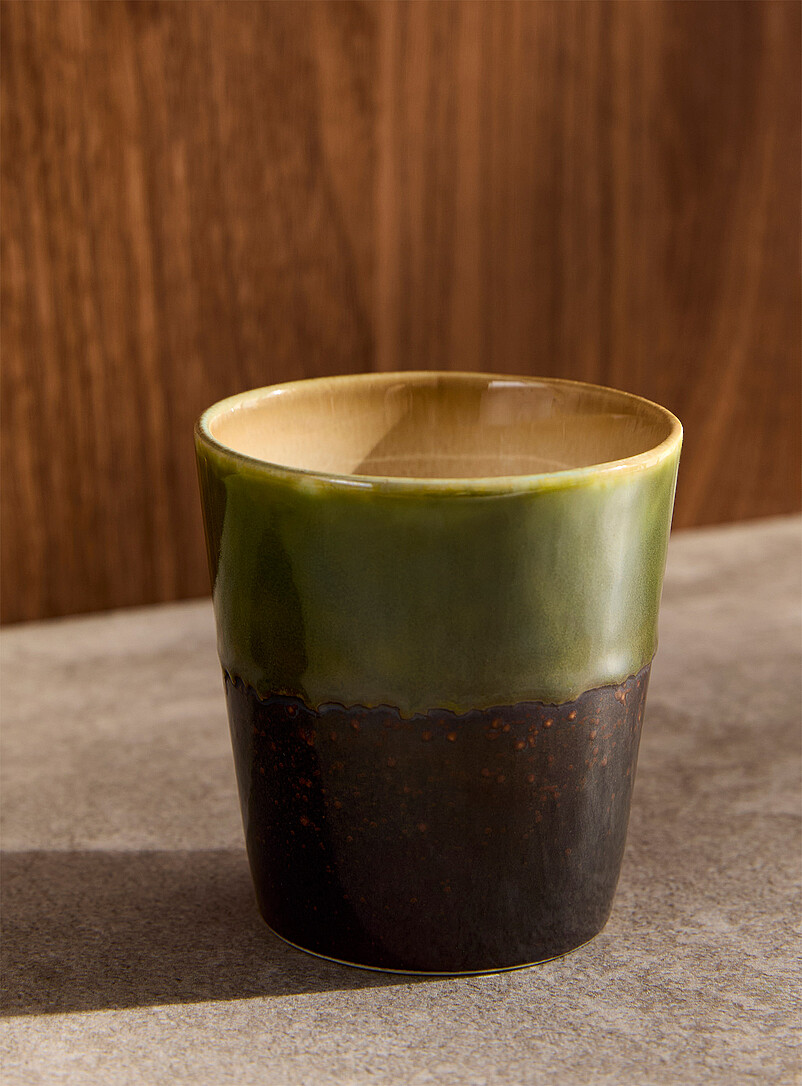
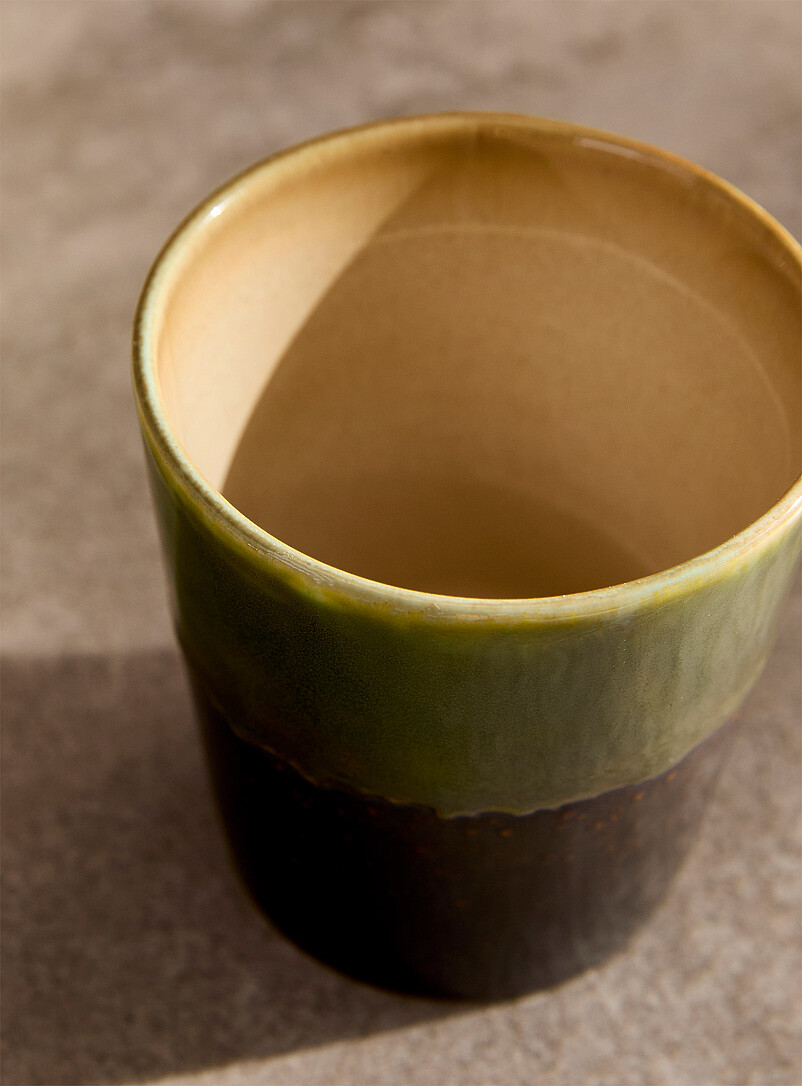
This is a small ceramic drinking cup with a hand-applied reactive glaze, featuring an olive green upper exterior, dark brown lower exterior, and a glossy beige interior. It is suitable for serving beverages, and is dishwasher and microwave safe. Each piece measures 3 inches (7.5 cm) in diameter and 3.25 inches (8 cm) tall, with slight variations in glaze appearance due to the hand-finishing process.
- Material
- shiny ceramic
- Style
- vintage
- Category
- Home & Garden > Kitchen & Dining > Barware
Specifications
A charming small ceramic glass with a reactive glaze, inspired by 1970s nature and pottery.
Hand-applied reactive glaze makes each piece unique. Dishwasher and microwave safe.
- Material
- shiny ceramic
- Style
- vintage
- Age Group
- adult
- Condition
- new
- Dimensions
- 3x3x3.25 in
- Category
- Home & Garden > Kitchen & Dining > Barware
Additional Attributes
- shiny ceramic
- reactive glaze
- hand-applied
- unique
- dishwasher safe
- microwave safe
- 1970s inspired
Product Insights
This ceramic rocks glass from HKLIVING's 70s Ceramics collection combines the individuality of hand-brushed reactive glaze—each piece has a non-repeating pattern with specks, bubbles, or drips sealed in a vitrified finish—with modern convenience: dishwasher and microwave safe, lead-free, and food-safe. Inspired by 1970s studio pottery and earthy colors like Khaki, Sage, and Olive, it holds 6–7 oz, performing as an espresso cup, dessert bowl, or rocks glass. Ceramic retains heat 11% longer than glass while staying cool to the touch, and at CAD 18 it sits above mass-market mugs yet below hand-thrown pottery, offering durable uniqueness as a functional tradeoff.
Verified claims
- Pattern uniqueness
- Each glass has a non-repeating pattern from hand-brushed reactive glaze.
- Food safety
- Reactive glaze is lead-free and food-safe.
- Design inspiration
- Earthy colorways and irregular glaze patterns are inspired by 1970s studio pottery.
- Design heritage
- Part of HKLIVING's 70s Ceramics collection, where glaze irregularities are officially listed as features, not flaws.
- Reactive glaze
- Ceramic with hand-applied reactive glaze that creates permanent, unique patterns (specks, bubbles, drips) sealed in a vitrified finish.
- Color story
- Color options Khaki, Sage, Olive reference the 1970s ecological palette.
- Glaze uniqueness
- No two glasses in the same color have identical glaze patterns.
- Drink volume
- 6–7 oz capacity fits flat white, cortado, and traditional cappuccino.
- Heat retention
- Ceramic retains heat 11% longer than glass, preserving coffee's aroma.
- Comfortable hold
- Ceramic outer wall stays cooler than glass for comfortable hold.
- Microwave convenience
- Microwave-safe ceramic allows heating liquids directly in cup.
- Dessert serving
- Ceramic retains cold for chilled layered desserts like tiramisu, chocolate mousse, or fruit-and-cream parfaits.
- Rocks glass
- Serves as a compact rocks glass for spirits with ice
- Hot beverage suitability
- Microwave-safe and compact (3.25x3 in) make it practical for espresso and small tea servings.
- Value
- CAD 18 is about 40–50% above HKLIVING's European RRP for similar mugs, and far below hand-thrown studio pottery.
- Pattern permanence
- Vitrified glaze permanently seals the hand-applied pattern; it won't fade or scrub off.
- Dishwasher safe
- Dishwasher and microwave safe; pattern withstands cleaning and heat.
- Reactive glaze details
- The reactive glaze can show small black specks, tiny air bubbles, and subtle drips as normal byproducts of the hand-applied process.
- Exact dimensions
- The tumbler is 3 inches in diameter and 3.25 inches tall.
Product record
- Title
- Natural Expression Small Glass
- Brand
- HKLIVING
- Price
- 18 CAD
- Availability
- In stock
Buying Guide
1 comparison · 6 sourcesUses
Product comparison
Compared within this brand.
| Natural Expression Small Glass: Choose this if you want a small, handle-free ceramic drinking cup with 1970s-inspired nature-and-pottery styling in khaki/sage/olive tones — it measures about 3 inches in diameter and 3.25 inches tall, with a glossy light-beige interior and a two-tone exterior where glossy green meets a darker, speckled matte brown at an irregular wavy seam. The hand-applied reactive glaze makes each piece unique, so expect some variation from the photo, and note that although it is listed under glassware, the listed material is ceramic. It is dishwasher and microwave safe.[1,3] | Dusk Stripes Small Glass: Choose this if you want a small, everyday cup with a 1970s-inspired look — it has colourful stripes described by the retailer as reminiscent of sunsets, with a speckled matte exterior, glossy interior, and smooth rounded rim. It is ceramic (despite the glass name), measures 3 inches in diameter by 3.25 inches tall, and is dishwasher and microwave safe. Note that the band transitions are soft, slightly irregular gradients rather than crisp lines, which shapes its handmade-looking character.[4,5,6] |
Image Analysis
3 images- 01
Product
A two-tone glazed short drinking cup with a glossy light-beige interior, a glossy olive-green upper exterior, and a darker matte brown lower exterior separated by an irregular wavy glaze boundary.
- Overall shapeCylindrical cup that tapers slightly inward toward the base with a continuous rim and no visible handle.
1 region
x 0.20 · y 0.20 · w 0.60 · h 0.65 (high) - Interior finishInterior surface is a smooth glossy light-beige glaze visible across the inside and along the rim.
1 region
x 0.33 · y 0.12 · w 0.34 · h 0.18 (high) - Upper exterior glazeUpper exterior has a glossy olive-green glaze that slightly pools near the irregular transition to the lower color.
1 region
x 0.28 · y 0.28 · w 0.44 · h 0.25 (high) - Lower exterior glazeLower exterior is a darker brown glaze with a matte to semi-matte appearance and visible small darker speckling; the top edge of this band has an uneven wavy line where the green glaze meets it.
1 region
x 0.28 · y 0.48 · w 0.44 · h 0.33 (high) - Glaze join detailVisible irregular wavy boundary between the green upper glaze and the dark brown lower glaze, with slight dripping/pooling effect at the seam.
1 region
x 0.28 · y 0.45 · w 0.44 · h 0.10 (high) - Surface textureUpper areas are glossy and reflective; lower area appears less reflective with fine speckled texture visible on its surface.
1 region
x 0.28 · y 0.28 · w 0.44 · h 0.53 (high)
Other
Product shot on a neutral stone surface with a vertical wood-grain backdrop; soft directional lighting from the right casts a shadow to the left.
- BackgroundVertical medium-brown wood-grain backdrop occupying the upper half of the image behind the cup.
1 region
x 0.00 · y 0.00 · w 1.00 · h 0.45 (high) - Supporting surfaceFlat neutral light-gray/beige stone or concrete surface under the cup with subtle texture.
1 region
x 0.00 · y 0.45 · w 1.00 · h 0.55 (high) - Shadow and lightingSoft directional lighting from the right side produces a shadow projecting leftward and a bright highlight on the cup's right rim and upper exterior.
- Image framingCup is centered vertically and horizontally, photographed at a slight downward angle showing interior and exterior simultaneously.
1 region
x 0.20 · y 0.20 · w 0.60 · h 0.65 (high)
Colors
light beige· interior and rimolive green· upper exterior#966935dark brown· lower exterior#2D221C- Overall shapeCylindrical cup that tapers slightly inward toward the base with a continuous rim and no visible handle.
- 02
Product
Close-up of a single cylindrical drinking vessel showing the interior rim, a glossy green upper exterior band and a darker brown lower exterior with a visible glaze transition seam.
- Overall shapeVertically oriented cylinder with an open top; walls appear uniformly thick and the rim is rounded.
1 region
x 0.12 · y 0.02 · w 0.76 · h 0.96 (high) - Interior finishSmooth matte beige interior visible from above with a continuous single-color surface and subtle circular firing marks near the rim.
1 region
x 0.20 · y 0.05 · w 0.60 · h 0.40 (high) - Rim detailRounded rim with thin glossy glaze that is slightly lighter than the interior, forming a narrow band around the top edge.
1 region
x 0.12 · y 0.02 · w 0.76 · h 0.12 (high) - Upper exterior glazingGlossy green glaze occupies the top exterior band; glaze shows subtle tonal variation and a slightly dripping or uneven lower edge where it meets the darker area.
1 region
x 0.12 · y 0.14 · w 0.76 · h 0.20 (high) - Lower exterior finishDarker brown lower exterior with a less reflective, slightly textured appearance and small irregular lighter spots near the seam under the green glaze.
1 region
x 0.18 · y 0.34 · w 0.64 · h 0.58 (high) - Glaze transition seamVisible horizontal transition line where the green upper glaze overlaps the dark lower glaze, creating an irregular wavy boundary.
1 region
x 0.12 · y 0.30 · w 0.76 · h 0.12 (high)
Other
Studio close-up photograph taken from an elevated angle showing the top and side of the vessel; soft directional lighting creates a long shadow to the left and background is a textured neutral surface.
- Shot compositionClose-up top-quarter angled view showing interior and upper exterior; product is framed centrally and cropped at the lower edge.
- Background and surfaceTextured neutral beige-brown flat surface fills the background and base under the product.
- Lighting and shadowSoft directional light from the right creates a defined shadow cast to the left and a highlight on the glazed upper exterior and rim.
1 region
x 0.00 · y 0.54 · w 0.50 · h 0.28 (medium) - Image cropLower portion of the cylinder is cropped by the image bottom, obscuring the base.
Colors
warm beige· interior#DCBA8Dmoss green· upper exterior glaze#9C6D3Adeep brown· lower exterior glaze#3C2C23- Overall shapeVertically oriented cylinder with an open top; walls appear uniformly thick and the rim is rounded.
- 03
Product
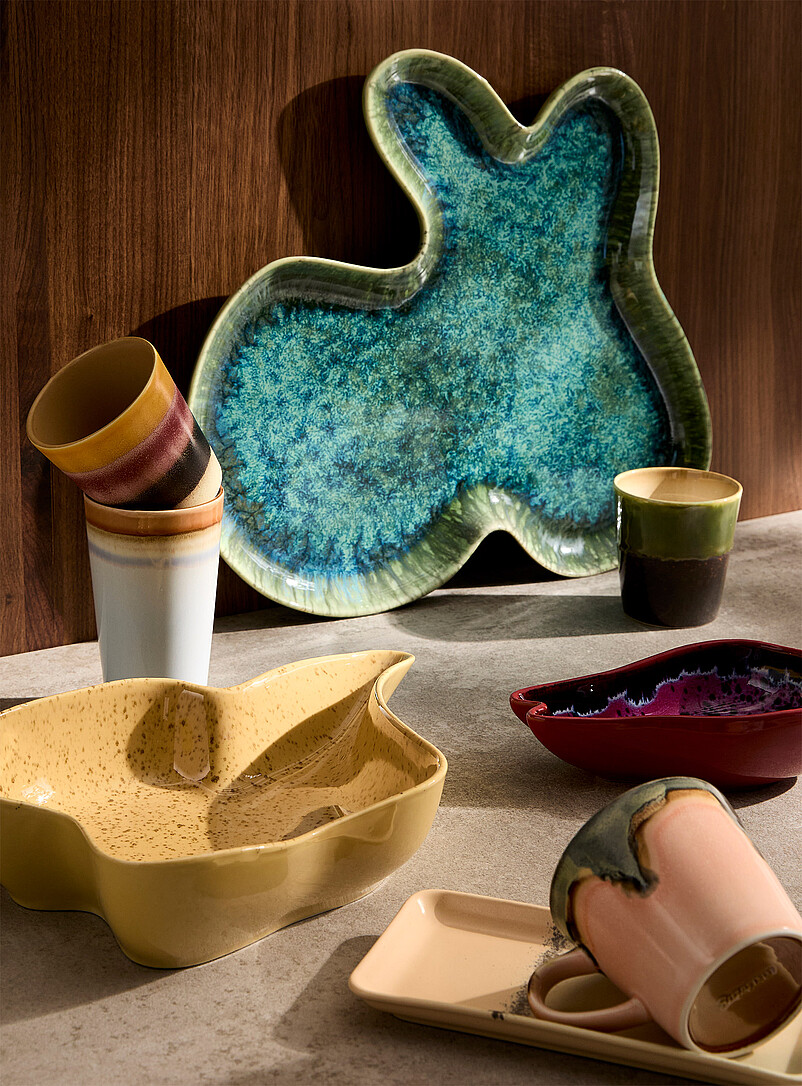
Multiple glazed ceramic pieces arranged on a flat stone surface against a wood backdrop: a large irregular turquoise-green platter at rear, a yellow speckled bowl in front, a pink mug with gray drip at lower right on a rectangular dish, a deep red bowl with purple interior, stacked striped cups and a tall pale cup, plus a small two-tone green cup at rear right.
- Large irregular platterLarge irregularly shaped shallow platter with a curving organic outline resembling a stylized butterfly or cloud; interior shows a dense mottled turquoise-to-deep-teal glaze with crystalline or speckled texture and a darker green rim with glossy finish.
1 region
x 0.28 · y 0.03 · w 0.58 · h 0.58 (high) - Yellow speckled bowlShallow yellow bowl with irregular lobed rim and interior covered in darker fine brown speckling; glossy ceramic finish and rounded exterior walls visible in foreground left.
1 region
x 0.03 · y 0.62 · w 0.54 · h 0.33 (high) - Pink mug with gray dripTipped pink ceramic mug with a thick gray drip-glaze effect around the rim and upper exterior, showing the mug lying on its side on a rectangular pale dish; handle and base visible.
1 region
x 0.67 · y 0.70 · w 0.30 · h 0.24 (high) - Rectangular dish under mugSmall rectangular shallow dish in a pale beige or cream color with rounded inner corners, supporting the tipped mug.
1 region
x 0.55 · y 0.78 · w 0.35 · h 0.12 (high) - Deep red bowl with purple interiorElongated deep red ceramic bowl with glossy exterior and a contrasting glossy interior showing a purple and black reactive glaze pattern along the rim and center.
1 region
x 0.70 · y 0.53 · w 0.26 · h 0.16 (high) - Stacked striped cupsA small stack of two cups at left midground: the top cup has horizontal broad stripes in rust, black and tan; the lower cup is pale with a warm tan rim, both with glossy finishes and one tilted into the other.
1 region
x 0.02 · y 0.35 · w 0.22 · h 0.28 (high) - Tall pale cupTall straight-sided cup behind the stacked cups, pale off-white or very light gray with a thin warm tan band near the rim, glossy exterior.
1 region
x 0.08 · y 0.36 · w 0.12 · h 0.28 (medium) - Small two-tone green cupShort cup at rear right with a glossy two-tone glaze: olive green on the upper half transitioning to a darker brown or black lower half.
1 region
x 0.78 · y 0.37 · w 0.12 · h 0.18 (high)
Other
Lifestyle staging on a textured stone-like surface with a vertical wood grain panel background; directional warm lighting from upper left producing defined shadows and glossy highlights on glazed surfaces.
- Background wood panelVertical medium-dark wood grain panel used as background occupying the upper half of the image.
1 region
x 0.00 · y 0.00 · w 1.00 · h 0.45 (high) - Supporting surfaceFlat light-gray textured stone or concrete surface forming the horizontal plane where pieces rest.
1 region
x 0.00 · y 0.45 · w 1.00 · h 0.55 (high) - Lighting and shadowsWarm directional lighting from upper left creating strong reflections on glazed ceramics and cast shadows to the lower right of objects.
- Shot compositionThree-quarter elevated viewpoint capturing foreground and background pieces with shallow depth of field; entire scene centered horizontally with cropping at image edges for some objects.
Colors
mottled turquoise· large platter interiorolive green rim· large platter rim#643B22speckled mustard yellow· yellow speckled bowl#E4B265muted pink· pink mug body#EAB395charcoal gray drip· pink mug dripgloss deep red· deep red bowl exteriorreactive purple· deep red bowl interiorrust stripe· striped cup outer band#9B5B04pale cream· tall cup bodyolive to dark brown· small two-tone green cup#AC7B3C- Large irregular platterLarge irregularly shaped shallow platter with a curving organic outline resembling a stylized butterfly or cloud; interior shows a dense mottled turquoise-to-deep-teal glaze with crystalline or speckled texture and a darker green rim with glossy finish.