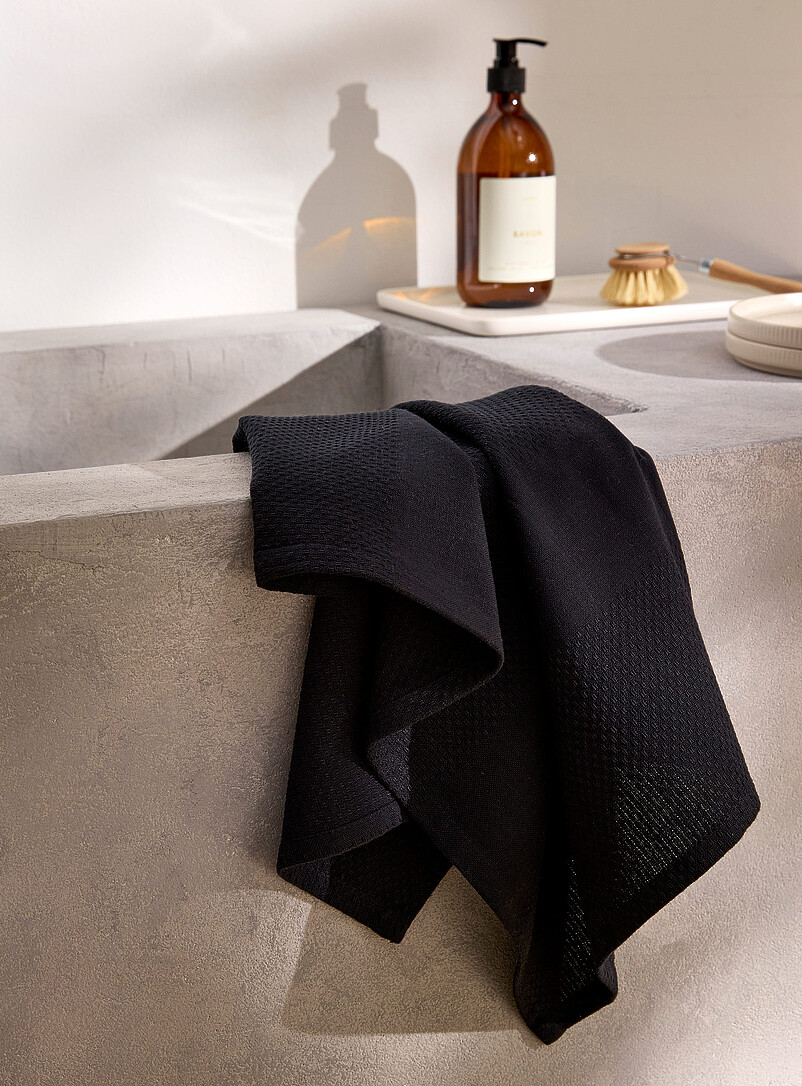
Simons Maison
Monochromatic Jacquard Tea Towel
This is a monochromatic jacquard tea towel made from 100% recycled cotton, measuring 19.75 by 27.5 inches (50 by 70 cm) with a practical hanging loop on the trim. Its primary use is for drying and wiping dishes and hands, and it is machine washable and dryable for easy care. This Simons Maison exclusive, designed in Canada, features a textured jacquard weave and hemmed edges.
- Category
- Home & Garden > Kitchen & Dining > Kitchen Tools & Utensils
Size
Specifications
- Material
- 100% reprocessed cotton
- Condition
- new
- Category
- Home & Garden > Kitchen & Dining > Kitchen Tools & Utensils
Product Insights
The Monochromatic Jacquard Tea Towel from Simons Maison is a 100% reprocessed cotton towel with a jacquard weave that provides even water absorption across the entire surface and does not reduce absorbency. Initially, the towel sheds lint and lacks absorbency, but after 3–5 washes it becomes absorbent and lint-free. The woven pattern, made from dyed yarns, is durable and won't peel, crack, or snag, and the contrast endures with proper care. However, dark dyes may bleed initially, so cold washes with vinegar and shade drying are recommended to prevent fading. The towel shrinks 3–5% after the first wash. At a regular price of CAD 7.50 or sale price of CAD 4.99, it undercuts most recycled-cotton tea towels by over 50%.
Verified claims
- Break-in
- Absorbency improves and lint shedding decreases significantly after 3–5 washes.
- Jacquard weave
- Jacquard weave provides even water absorption across the entire towel.
- Maintenance
- Dark dyes may bleed initially; cold wash, vinegar, and shade drying prevent fading.
- Wash care
- Machine wash cold (30°C max) on gentle cycle and tumble dry on low heat; skip fabric softener.
- Weave performance
- Woven jacquard doesn't snag or hinder absorbency; absorbency improves after a few washes.
- Durability
- Woven from dyed yarns, the pattern won't peel, crack, or snag, and the contrast endures with cool washes and shade drying.
- Material
- 100% reprocessed cotton avoids the impact of cotton cultivation and dyeing steps.
- Price comparison
- Sale-priced CAD 4.99, it undercuts most recycled-cotton tea towels by over 50%.
- Linting
- Lint shedding decreases significantly after 3–5 washes.
- Shrinkage
- May shrink 3–5% in the first machine wash and dry, as is typical for 100% cotton; washing in cold water and tumble drying on low heat helps minimize it.
- Dye bleeding
- Dark colors may bleed on initial washes.
- Recycled content
- Made from 100% reprocessed cotton, so it diverts textile waste from landfill and avoids virgin cotton cultivation and dyeing.
- Drying dishes
- After a few washes, this towel performs well for everyday drying of dishes and glasses, and skipping fabric softener keeps it from just pushing water around.
Product record
- Title
- Monochromatic Jacquard Tea Towel
- Brand
- Simons Maison
- Price
- 7.5 CAD
- Availability
- In stock
Image Analysis
2 images- 01
Product
A single dark monochrome jacquard tea towel draped over the edge of a concrete sink; visible folded drape, hemmed edges and a small-scale textured weave are shown on the towel surface.
- Overall drapeLarge rectangular towel draped over the sink lip with two main vertical folds: an upper fold lying across the lip and a longer lower panel hanging down the front of the sink.
1 region
x 0.18 · y 0.26 · w 0.64 · h 0.66 (high) - Hemmed edgeVisible narrow hem along the towel edges, forming a clean stitched border around the visible perimeter.
1 region
x 0.30 · y 0.44 · w 0.40 · h 0.22 (high) - Jacquard textureSmall-scale repeating textured weave (subtle waffle or diamond jacquard pattern) visible across the towel surface, most apparent where light grazes the fabric.
1 region
x 0.56 · y 0.52 · w 0.28 · h 0.36 (high) - Folded cornerLower right corner shows an inward fold creating a pointed hanging tip with layered fabric thickness visible at the corner.
1 region
x 0.46 · y 0.72 · w 0.26 · h 0.24 (high) - Color appearanceTowel appears uniformly very dark, visually black without printed patterns or contrasting trims.
Other
Lifestyle scene showing towel draped over a textured concrete sink with nearby countertop items and soft directional lighting from the left producing shadows on the wall.
- Concrete sink and ledgeAngular concrete sink and surrounding ledge with a rough textured finish forms the support the towel is draped over.
1 region
x 0.02 · y 0.38 · w 0.96 · h 0.56 (high) - Amber pump bottleTall amber glass or plastic pump bottle with a light-colored rectangular label sits on a tray behind the sink; bottle casts a distinct shadow on the wall.
1 region
x 0.60 · y 0.04 · w 0.14 · h 0.22 (high) - Small dish brush propShort-handled round-bristle dish brush and a light round dish are placed on the countertop to the right of the bottle.
1 region
x 0.72 · y 0.08 · w 0.20 · h 0.10 (high) - Lighting and shadowSoft directional light from the left produces a warm highlight on the bottle and a crisp bottle-shaped shadow on the wall behind; the towel shows gentle shading emphasizing folds.
- Shot compositionFramed vertically with the towel as the central foreground subject and countertop items arranged in the midground and background; neutral wall background with visible shadow.
Colors
black· towel main#0E0D0Ccharcoal highlight· towel textured highlights#312C2Eamber· bottlePackaging#8B3C02- Overall drapeLarge rectangular towel draped over the sink lip with two main vertical folds: an upper fold lying across the lip and a longer lower panel hanging down the front of the sink.
- 02
Product
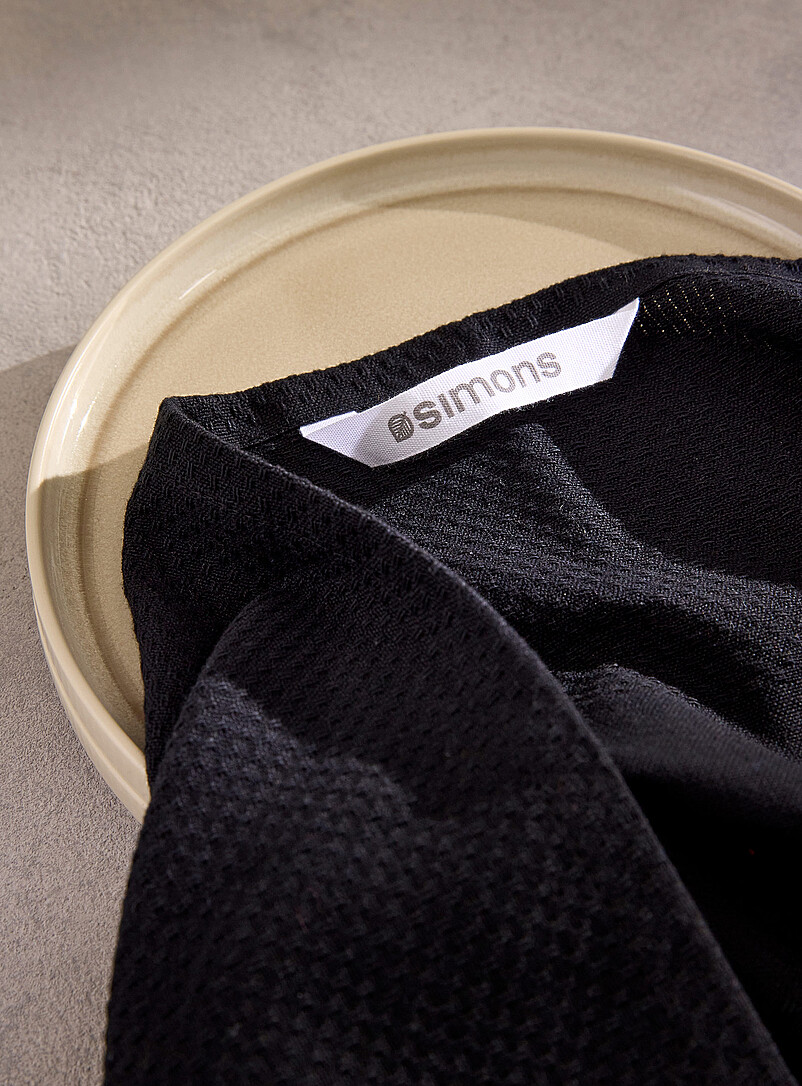
A folded black jacquard tea towel with a small repeating textured weave, showing a sewn white brand label near one hem. The towel is draped over a beige glossy ceramic plate; visible edges show a narrowly turned hem.
- Main fabric appearanceBlack woven jacquard fabric with a small repeating geometric texture visible across the surface; texture produces subtle sheen highlights on raised areas.
1 region
x 0.02 · y 0.32 · w 0.96 · h 0.64 (high) - Fold and drapeTowel is folded and draped with soft rounded folds and a visible inner crease creating a gentle shadowed valley near the center-right of the image.
1 region
x 0.40 · y 0.30 · w 0.56 · h 0.46 (high) - Hem detailNarrow turned hem along the towel edge with slightly denser stitching visible against the black fabric at the upper edge.
1 region
x 0.22 · y 0.14 · w 0.60 · h 0.12 (high) - Sewn labelWhite woven fabric label sewn into the inner hem, protruding from the towel edge; label shows printed brand text and a round leaf-like logo to the left.
1 region
x 0.54 · y 0.14 · w 0.32 · h 0.11 (high) - Label text“simons”
1 region
x 0.60 · y 0.16 · w 0.24 · h 0.07 (high) - Label logo“a small circular leaf-like icon immediately left of the word simons”
1 region
x 0.56 · y 0.17 · w 0.04 · h 0.06 (high)
Other
Image shows the towel arranged on a beige glossy ceramic plate set on a neutral light grey textured surface, with soft directional lighting from upper left creating gentle shadows and highlights.
- PlateBeige glossy ceramic plate with a raised rim partially visible under the towel toward the upper left quadrant.
1 region
x 0.02 · y 0.04 · w 0.68 · h 0.44 (high) - Surface and backgroundNeutral light grey textured tabletop or backdrop visible around the plate, providing a matte background.
2 regions
x 0.00 · y 0.00 · w 1.00 · h 0.20 (medium); x 0.00 · y 0.80 · w 1.00 · h 0.20 (medium) - Lighting and shadowSoft directional lighting from upper left produces highlights on the plate rim and mild cast shadows from the towel toward lower right.
- Shot compositionClose-up detail shot framed to emphasize fabric texture and label; image cropped so towel fills most of the frame with plate acting as a backdrop.
Colors
deep black· main fabric#191316bright white· brand labelmedium grey· label text and logowarm beige· plate visible under towel#DCC9AD- Main fabric appearanceBlack woven jacquard fabric with a small repeating geometric texture visible across the surface; texture produces subtle sheen highlights on raised areas.
Variants
7 SKUs| SKU | Title | Price | Avail |
|---|---|---|---|
| 4558206 | Monochromatic Jacquard Tea Towel - Black - T.towel | CA$4.99CA$7.50 | Yes |
| 4558208 | Monochromatic Jacquard Tea Towel - Off White - T.towel | CA$4.99CA$7.50 | Yes |
| 4650285 | Monochromatic Jacquard Tea Towel - Mossy Green - T.towel | CA$4.99CA$7.50 | Yes |
| 4650286 | Monochromatic Jacquard Tea Towel - Indigo/dark Blue - T.towel | CA$4.99CA$7.50 | Yes |
| 4650287 | Monochromatic Jacquard Tea Towel - Burgundy - T.towel | CA$4.99CA$7.50 | Yes |
| 4650288 | Monochromatic Jacquard Tea Towel - Sunflower Yellow - T.towel | CA$4.99CA$7.50 | Yes |
| 4650289 | Monochromatic Jacquard Tea Towel - Citrus/bright Orange - T.towel | CA$4.99CA$7.50 | Yes |
Documents & Data
Customer Reviews
10 total10 reviews · out of 5
j aime bien
bonne absoption beau tissu
Tissus Trop mince
Tissus Trop mince
Parfait
J’aime le tissus! Essuie bien!
Nice tea towel
Not much else to say really. I think Simon's home range is good quality and good value for money.
Jacquard tea towels
Excellent quality for the price. Did not shrink or change colour (red ).
Beautiful and Practical
Very absorbant. A practical and beautiful addition to the kitchen.
tea towel
Very nice and thick for easy drying of dishes.
Love Them!
Exactly what I wanted, with a good price (sale) and speedy delivery. Thanks!
De qualité.
Chic!
Not absorbent
The large size is excellent, but they are not very absorbent.