Gus*
Strand Danish Rope Chair
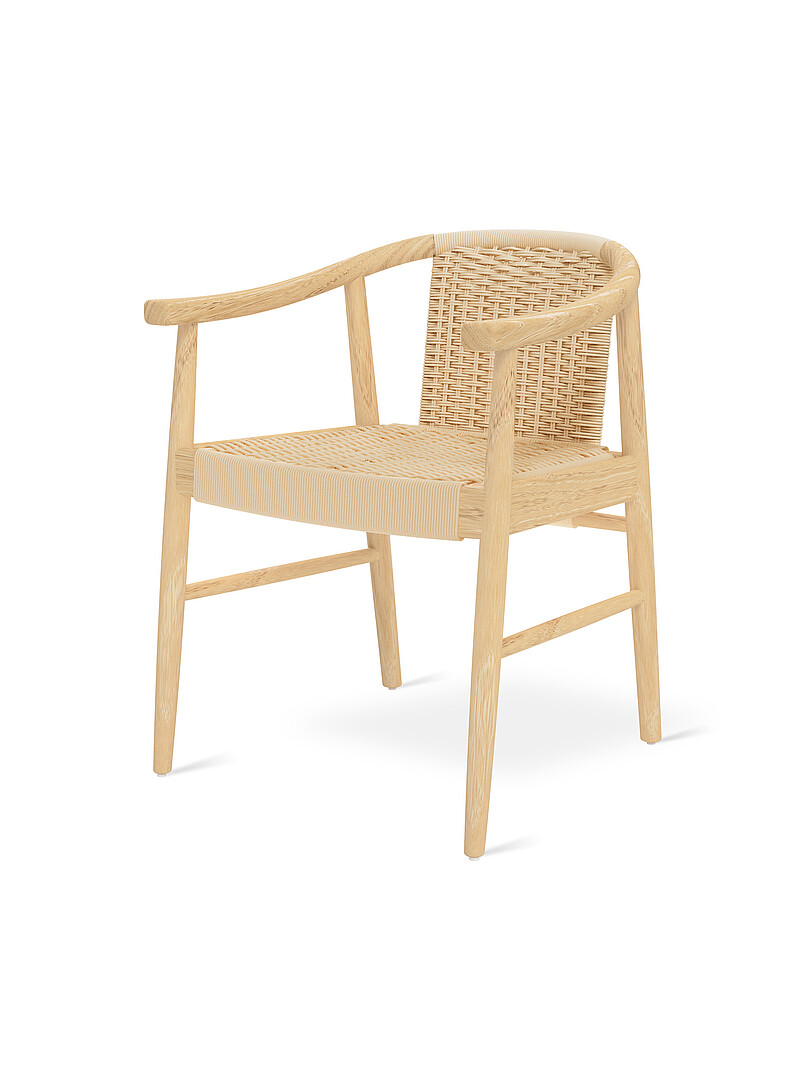
The Strand Danish Rope Chair, by Canadian brand Gus and sold at Simons Maison, is a solid blond oak dining chair with a woven Danish cord seat and backrest. It features a continuous curved arm and back rail, tapered legs, and side stretchers, and measures 33 inches high by 24 inches wide by 25 inches deep (84 x 61 x 63.5 cm).
- Color
- blond oak
- Material
- Solid blond oak frame and Danish cord seat and backrest
- Category
- Furniture > Chairs > Kitchen & Dining Room Chairs
Specifications
Scandinavian dining chair with solid blond oak frame and finely woven Danish cord seat and backrest.
Handcrafted details, soft curves, and Danish cord woven seat and backrest provide exceptional comfort.
- Color
- blond oak · yellow
- Material
- Solid blond oak frame and Danish cord seat and backrest
- Secondary
- paper
- Gender
- unisex
- Age Group
- adult
- Condition
- new
- Dimensions
- 25x24x33 in
- Category
- Furniture > Chairs > Kitchen & Dining Room Chairs
Additional Attributes
- solid oak frame
- Danish cord seat and backrest
- handcrafted details
- soft curves
- Scandinavian sophistication
- high-end craftsmanship
Product Insights
This chair uses traditional Danish cord weaving (single strand as Wegner's 1949 Wishbone) for even weight suspension and breathability, keeping cool in warm weather. Made from renewable wood pulp and white oak, it is plastic-free and biodegradable. Over 5–10 years, the cord darkens and oak warms to honey. The frame can be sanded and refinished, and the cord can be repaired or re-woven, giving a 30–50 year lifespan. However, maintaining this natural beauty requires annual hardwax oil on the frame and regular vacuuming of the cord, plus gentle spot cleaning without soaking.
Verified claims
- Design heritage
- Danish cord hand-woven from a single strand as in Wegner's 1949 Wishbone Chair.
- Comfort
- Woven seat suspends bodyweight evenly and stays cool in warm weather.
- Durability
- Seat re-weavable, frame sandable—functional lifespan of 30–50 years.
- Sustainability
- Danish cord is made from renewable wood pulp, is biodegradable, and its production involves no petroleum-based plastics.
- Suspension
- Each cord strand flexes independently, distributing weight evenly for comfort without padding.
- Breathability
- Danish cord is naturally breathable, keeping the seat cool against the skin.
- Patina
- Cord darkens to amber and oak warms to honey over 5–10 years.
- Care
- Maintain with yearly hardwax oil on frame and vacuum of cord.
- Weave technique
- Continuous cord weave with no knots and triple‑ply waxed paper.
- Materials
- White oak and Danish paper cord: cord is made from wood pulp, biodegradable, plastic-free, with no foam or synthetic padding.
- Cleaning routine
- Vacuum regularly and spot clean with mild soap; never soak the cord.
- Wood maintenance
- Apply hardwax oil annually; the oak frame can be sanded and refinished.
- Cord longevity
- Fray-resistant cord can be repaired strand-by-strand or completely re-woven.
- Seat height
- The seat height is 18.5 inches (47 cm).
- Long meal comfort
- The woven cord seat can feel comfortable through a multi-course dinner despite having no padded seat, because each strand flexes independently under body weight to distribute pressure.
- Frame finish
- The frame finish is a light natural oak marketed as Royal Oak; the yellow colour label in the product listing corresponds to this blonde natural oak.
- Frame hardness
- The white oak frame has a Janka hardness around 1360—roughly twice that of black cherry and 30% harder than teak—so it resists dents and scratches from daily dining knocks.
Product record
- Title
- Strand Danish Rope Chair
- Brand
- Gus*
- Price
- 795 CAD
- Availability
- In stock
Buying Guide
1 comparison · 7 sourcesUses
Add Scandinavian style to your dining room
This dining chair brings Scandinavian sophistication to a dining room, with a solid blond oak frame and handcrafted details. Its finely woven Danish cord seat and backrest add a naturally elegant texture while providing exceptional comfort for everyday seating.[1]
Product comparison
Compared within this brand.
| Strand Danish Rope Chair: Choose this if you want a Scandinavian-style dining chair with a solid white oak frame and a finely woven Danish paper cord seat and backrest, which the merchant describes as providing exceptional comfort and a naturally elegant texture. It measures 33 inches tall, 24 inches wide, and 25 inches deep, with a continuous curved top rail forming the armrests and a light natural, matte wood finish. The comfort and craftsmanship praise comes from the merchant's own description, so treat it as the brand's positioning rather than independent testing.[1,2,3] | Black Ash Wood Architectural Chairs Set Of 2: Choose this if you want a set of 2 solid ash wood dining chairs with an architectural look—the angular design creates the illusion of a floating seat, and the black lacquered matte finish highlights the wood's natural grain. Each chair stands 30.5 inches tall with an 18-inch seat height, 18-inch width, and 19-inch depth, so check those dimensions against your table and space. Note that some assembly is required.[4] | Malloy Oak Base Bouclé Chair: Choose this if you want an upholstered side chair with a cushioned seat and backrest in ivory, bouclé-feel fabric, set on a solid white oak frame with round blond oak legs that the merchant says bring a mid-century modern touch. This ONE SIZE, Off White variant measures 40 inches high, 33 inches wide, and 27.5 inches deep, with a rounded low back that curves smoothly into a thick, padded seat. Note that the comfort and ergonomic support are stated as design intent and the merchant's promotional description rather than verified user experiences.[5,6,7] |
Image Analysis
3 images- 01
Product
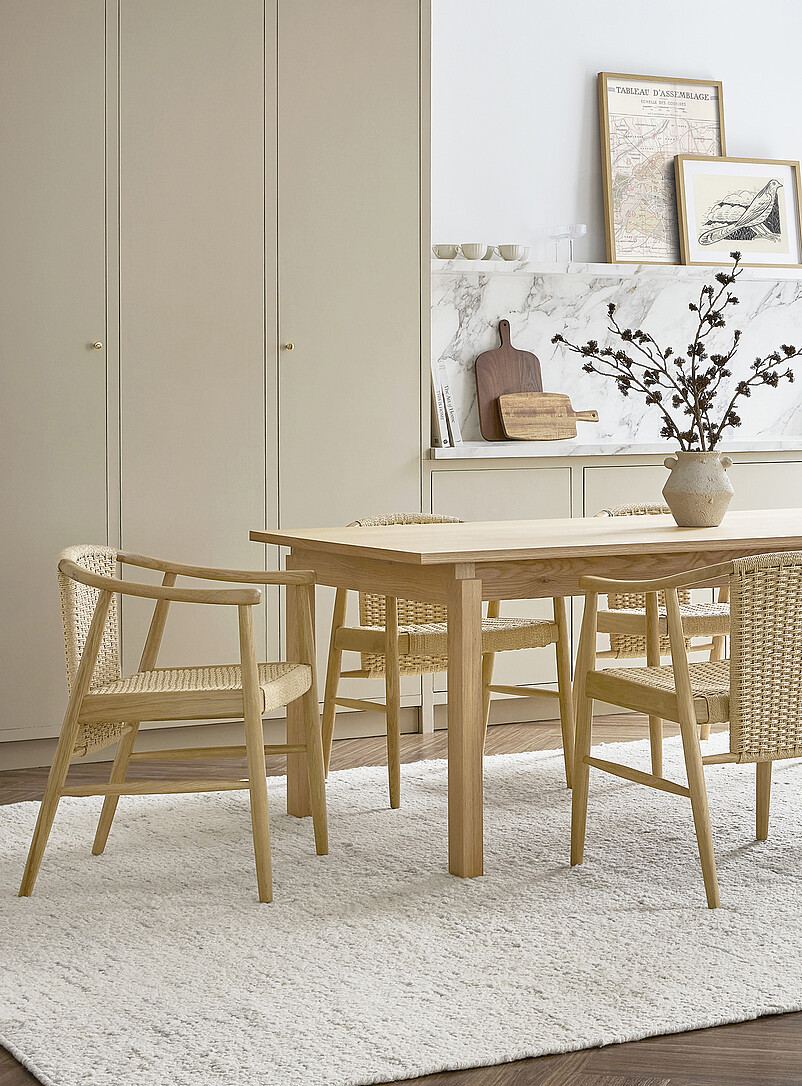
Light natural-wood framed dining chairs with continuous curved arm/crest rail and woven natural-fiber rope seat and back; chairs are shown around a wooden dining table with portions occluded by the table.
- Frame geometryVisible chairs have a light wood frame with tapered round legs, straight lower stretchers, and a continuous curved back/arm rail that wraps from one arm to the other.
2 regions
x 0.02 · y 0.46 · w 0.42 · h 0.44 (high); x 0.48 · y 0.52 · w 0.34 · h 0.41 (high) - Arm/crest railChair arm is a single continuous curved rail with a rounded rectangular cross-section, forming a low open armrest and rear crest.
1 region
x 0.02 · y 0.46 · w 0.30 · h 0.18 (high) - Seat materialSeat is woven rope or cord in a natural beige tone, tightly woven across the seat plane with visible texture.
2 regions
x 0.06 · y 0.64 · w 0.25 · h 0.13 (high); x 0.60 · y 0.68 · w 0.18 · h 0.10 (high) - Backrest constructionBackrest is a woven panel matching the seat material, spanning between the curved rail and the back legs; weave pattern visible on chair at right edge.
1 region
x 0.64 · y 0.53 · w 0.20 · h 0.25 (high) - FinishWood surfaces show a light natural, matte finish with visible wood grain on exposed frame members.
2 regions
x 0.02 · y 0.46 · w 0.42 · h 0.44 (medium); x 0.48 · y 0.52 · w 0.34 · h 0.41 (medium) - OcclusionLower portions of the chairs and some seat areas are partially occluded by the rectangular wooden dining table positioned in the foreground.
1 region
x 0.28 · y 0.47 · w 0.52 · h 0.30 (high)
Other
Lifestyle scene showing a light-wood dining table, decorative objects on a counter (cutting boards, framed prints), a ceramic vase with branches, a plush light rug, and a built-in cabinet background.
- Table visibleRectangular light-wood dining table with straight square legs occupies center foreground and visually overlaps the chairs.
1 region
x 0.25 · y 0.44 · w 0.58 · h 0.20 (high) - Decor and shelvingCounter shelf behind table holds two wooden cutting boards leaning against a marble backsplash, small stacked bowls, and two framed prints leaning on the shelf.
1 region
x 0.60 · y 0.07 · w 0.36 · h 0.22 (high) - Vase with branchesTextured ceramic vase in a neutral tone sits on the table near the right edge with tall dried-branch stems fanning upward.
1 region
x 0.74 · y 0.45 · w 0.12 · h 0.26 (high) - Rug and floorA plush off-white or very light beige area rug covers the floor under the table and chairs; wood-patterned floor visible at rug edges.
1 region
x 0.02 · y 0.79 · w 0.96 · h 0.18 (high) - Framed print text“TABLEAU D'ASSEMBLAGE”
1 region
x 0.76 · y 0.05 · w 0.18 · h 0.09 (high) - Small legible propsA vertical stack of small bowls or cups is visible on the shelf; details are visible but small.
1 region
x 0.61 · y 0.09 · w 0.10 · h 0.05 (medium) - Illegible book spinesNarrow vertical book spines are visible next to the cutting boards; text is too small to read at this resolution.Partial
1 region
x 0.59 · y 0.18 · w 0.05 · h 0.12 (medium)
Colors
light natural oak· wood frame#CAC3B5natural beige rope· woven seat and back#E4E2DC- Frame geometryVisible chairs have a light wood frame with tapered round legs, straight lower stretchers, and a continuous curved back/arm rail that wraps from one arm to the other.
- 02
Product
Three-quarter front view of a light natural wood chair with a continuous curved arm/back rail and woven rope seat and back panel; four tapered legs with horizontal stretchers.
- Frame geometrySolid four-leg wooden frame with slightly tapered cylindrical legs and horizontal stretchers connecting the front and rear legs on each side.
1 region
x 0.12 · y 0.28 · w 0.76 · h 0.56 (high) - Arm and back railContinuous curved top rail forming the armrests and rear support: the rail sweeps from one arm around the back to the other arm with a rounded rectangular cross section and visible wood grain.
1 region
x 0.20 · y 0.10 · w 0.60 · h 0.26 (high) - Seat constructionFlat woven rope seat with a tight horizontal/vertical braid pattern and a wrapped fabric or rope trim along the front edge of the seat.
1 region
x 0.20 · y 0.42 · w 0.48 · h 0.20 (high) - Back panel weaveWoven rope back panel with an open basket-weave pattern set within the curved rear rail and supported by short vertical uprights.
1 region
x 0.46 · y 0.18 · w 0.24 · h 0.28 (high) - Surface textureSmooth, light-finished wood showing visible grain; woven rope has a matte, fibrous texture.
Other
Studio product shot on a plain white seamless background with soft shadow beneath the chair; three-quarter front-right viewing angle.
- Shot compositionChair centered in frame, photographed from a slightly elevated three-quarter front-right angle.
- Background and shadowUniform white background with a soft diffuse shadow under and slightly to the right of the chair.
1 region
x 0.32 · y 0.76 · w 0.36 · h 0.12 (high) - Image qualityHigh-resolution, well-lit image with even lighting and no visible text or labels.
Colors
light natural oak· wood frame and arm rail#E3D2B4beige rope· woven rope seat and back#E3D3B4- Frame geometrySolid four-leg wooden frame with slightly tapered cylindrical legs and horizontal stretchers connecting the front and rear legs on each side.
- 03
Product
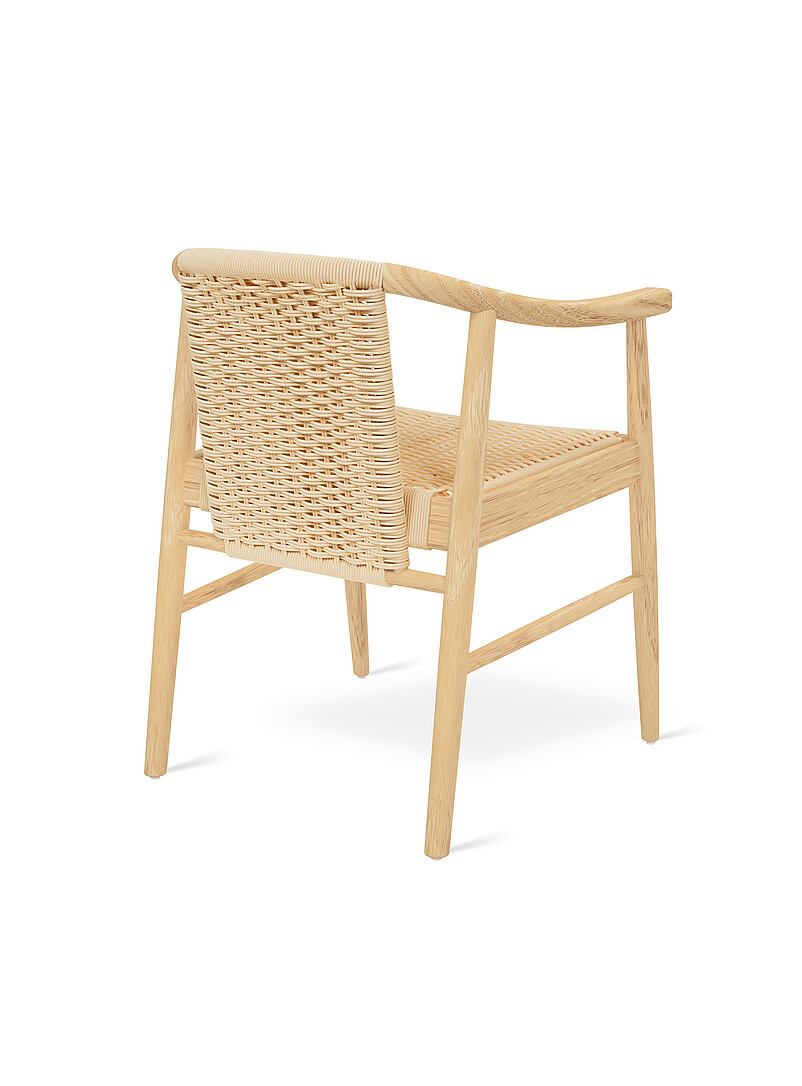
Rear three-quarter view of a wooden framed dining chair with woven rope seat and back; visible components include the woven back panel, woven seat, curved wooden top rail/arm, and four tapered wooden legs with stretchers.
- View and poseChair shown from the rear three-quarter angle, slightly turned to the right so the right arm and right rear leg are more visible than the left.
- Backrest constructionRectangular woven rope back panel with a dense horizontal-over-vertical weave pattern, wrapped at top around the curved wooden top rail.
1 region
x 0.18 · y 0.16 · w 0.34 · h 0.48 (high) - Seat constructionFlat woven rope seat with the same weave as the back, set into a wooden frame that forms the seat perimeter.
1 region
x 0.36 · y 0.42 · w 0.34 · h 0.20 (high) - Top rail and armSingle continuous curved wooden top rail that forms the rear of the armrest, rounded profile and smooth sanded finish, extending down into vertical arm supports.
1 region
x 0.40 · y 0.10 · w 0.46 · h 0.22 (high) - Legs and stretchersFour tapered round wooden legs with a light grain visible; horizontal stretchers connect front and rear legs on each side and a lower rear stretcher between the rear legs.
2 regions
x 0.12 · y 0.36 · w 0.20 · h 0.50 (high); x 0.62 · y 0.44 · w 0.22 · h 0.44 (high) - Material finishSmooth, light natural wood finish on frame and rails; woven rope has a matte natural-fiber appearance.
Other
Studio product photo on a plain white background with a soft drop shadow beneath the chair; even, diffuse lighting with minimal reflections and no props or packaging.
- Background and lightingPlain white background with uniform diffuse lighting and a soft gray shadow under the chair indicating a studio setup.
- ShadowSoft elliptical shadow cast beneath and slightly to the right of the chair, matching the chair outline.
1 region
x 0.30 · y 0.72 · w 0.40 · h 0.14 (medium) - Image qualityHigh-resolution clear image with visible wood grain and weave texture, no visible compression artifacts.
Colors
light natural oak· wooden frame and legs#E4D3B4natural beige· woven rope (seat and back)#EAD5BB
Brand PDP Lookup
- Brand
- Gus*
Strand Dining Chair