Blomus
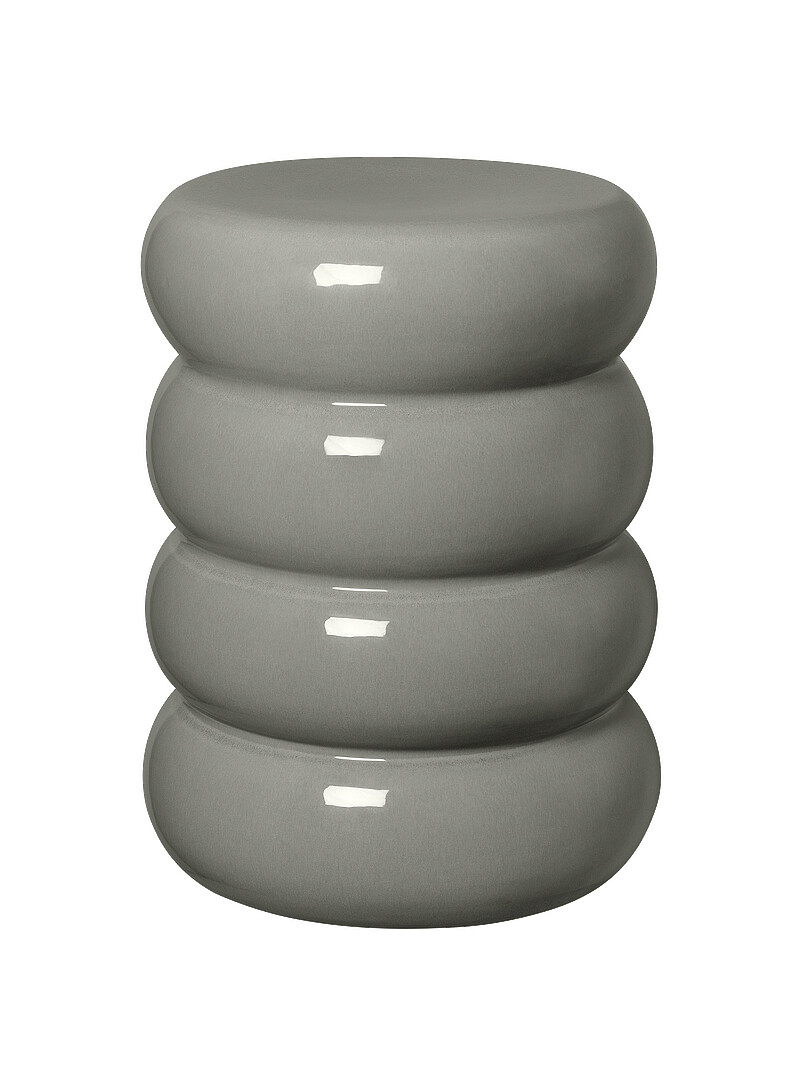
Toru Wavy Ceramic Side Table
The Toru Wavy Ceramic Side Table is a decorative cylindrical side table featuring a stack of four rounded, wavy horizontal lobes with a flat top, crafted from lacquered ceramic in a muted grey-green finish. It functions as a compact accent table for supporting drinks, decor, or lighting in living spaces, and requires no assembly. Specifications: 17.25 inches (44 cm) high, 13.5 inches (34 cm) in diameter, weighing 8 kg (17.64 lb).
- Material
- Lacquered ceramic
- Category
- Furniture > Tables > Accent Tables > End Tables
Color
Size
Specifications
A wavy lacquered ceramic side table with retro elegance.
Lacquered ceramic, no assembly required, wavy design.
- Material
- Lacquered ceramic
- Gender
- unisex
- Condition
- new
- Dimensions
- 13.5x13.5x17.25 in
- Category
- Furniture > Tables > Accent Tables > End Tables
Additional Attributes
- lacquered ceramic
- wavy design
- no assembly required
Product Insights
From a 1921 German bicycle-parts workshop, Blomus crafts the Toru Wavy Ceramic Side Table as a seamless slip-cast monocoque, supporting 200 lb with an 11:1 strength-to-weight ratio. Its fully vitrified, scratch-resistant glaze and flat 13.5-inch base ensure stability on low-pile carpet and hard floors, while the wavy rim guides objects to center, making it a deliberate display stage for curated pieces. However, the glaze is not frost-resistant, restricting use to indoors, and the wavy design prevents large flat items from resting near the edge—a tradeoff for centered aesthetics.
Verified claims
- Weight
- Rated at 200 lb and certified as an occasional stool.
- Stability
- Flat, 13.5 circular base provides stability on low-pile carpet and hard floors.
- Indoor use
- Cannot be used outdoors; glaze is not frost-resistant.
- Scratch resistance
- Fully vitrified glaze resists scratches and wipes clean.
- Construction
- Slip-cast as a single seamless ceramic piece that supports up to 200 lb.
- Design
- Wavy shape guides objects to center placement.
- Brand lineage
- Blomus, a German design house with craft pedigree since 1921.
- Heritage
- Brand originates from a 1921 German bicycle-parts workshop.
- Finish
- Non-porous, scratch-resistant glazed finish; indoor-only.
- Placement
- Wavy rim prevents large flat objects from sitting near the edge, guiding them to center.
- Display stage
- Table becomes a deliberate display stage for a few curated pieces.
- Load capacity
- Hollow monocoque supports 200 lb, 11:1 strength-to-weight.
- Craftsmanship
- Single-piece slip-cast: no seams or glue lines.
- Surface care
- Damp-wiping and coaster use keep the surface pristine.
- Durability
- Single-piece ceramic construction supports up to 200 lb and requires no structural upkeep.
Product record
- Title
- Toru Wavy Ceramic Side Table
- Brand
- Blomus
- Price
- 329 CAD
- Availability
- In stock
Deep Research
Speckle detail and texture across the color options
- The Toru collection’s ceramic surfaces are finished with a speckled gloss glaze that scatters fine, darker specks through the base color, so the grey colorway reads as naturally variegated rather than flat—adding a layer of visual interest that holds up to closer inspection.
How Toru compares to other ceramic side tables
- Blomus was founded in 1921 as a German bicycle-parts manufacturer and has been a family-run design house since 1961, evolving through four generations into an international design brand — choosing a Toru means furnishing with a piece that comes from a century of material craft, not a decor trend that appeared on a retailer’s shelf last season.
- Unlike mass-produced ceramic side tables assembled from separately fired parts, the Toru is slip-cast as a single monolithic form with a fully glazed surface — no visible seams or glue joints, which gives it a sculptural, gallery-object presence and eliminates weak points where cheaper tables fail over time.
- The manufacturer explicitly rates the Toru at 200 pounds, which is unusually high for a ceramic accent table — this certifies it as a functional stool, not just a perch for a book and a coffee cup, and sets it apart from the typical unrated ceramic tables that buyers hesitate to sit on.
How the wavy silhouette affects everyday use
- The variable rim height created by the waves means that a large flat object set near the edge may not sit flush if it bridges a concave section, naturally guiding users to position items centrally — which, in turn, keeps the sculptural outline visible and reinforces the table’s role as a display stage for a few curated pieces.
Why glazed ceramic furniture belongs indoors
- The table carries an explicit indoor-only instruction not because it is fragile, but because the glazed ceramic — like most decor-grade ceramics — lacks the vitrified, closed-pore body needed to resist freeze-thaw cycling; the glossy lacquer-like surface keeps dust and light scratches at bay indoors, but standing moisture trapped in micro-cracks would eventually cause spalling if left outside.
- Rated to support up to 200 lbs (95 kg), the Toru's single-block ceramic construction allows it to serve as an occasional stool — a structural limit that directly reflects the monobloc's compressive strength and sets it apart from thin-walled decorative ceramics that are too fragile for sitting.
Construction method behind the single‑piece ceramic design
- The table's seamless, joint-free form is typical of slip-casting, a method where liquid clay is poured into a plaster mold and forms a hollow shell as the mold absorbs water — this technique explains how a ceramic piece of these dimensions tips the scale at only 17.6 lb yet supports 200 lb, because the thin, continuous wall acts as a natural arch under vertical loads.
- With a maximum capacity of 200 lb (95 kg) published by the manufacturer, the Toru is explicitly rated to be used as a stool — a rare endorsement for decorative ceramic that gives owners confidence to use it for occasional seating without risking structural damage.
- The ‘lacquered ceramic’ finish is a fully vitrified glaze that bonds to the clay body during high-temperature firing, creating a hard, non-porous surface that resists scratches and is easily wiped clean — a more durable option than painted or lacquered wood alternatives.
- Because the table is molded as a single, seamless ceramic piece, it functions as a monocoque — the outer shell carries the entire load directly to the floor, eliminating the need for internal bracing and avoiding the wobble or racking that commonly develops in assembled tables with separate legs.
- The Toru is designated for indoor use only because the glazed ceramic is not frost-resistant — exposure to outdoor temperature swings and moisture would cause internal expansion and cracking, so the table must live in climate-controlled spaces.
Image Analysis
1 images- 01

Product
Front view of a glossy, stacked-ring ceramic side table composed of four rounded horizontal lobes forming a cylindrical wavy column and flat top.
- Overall shapeCylindrical column made of four stacked, rounded horizontal lobes with a flat, slightly convex circular top surface.
1 region
x 0.18 · y 0.03 · w 0.64 · h 0.94 (high) - Material and finishSmooth ceramic surface with a glossy, reflective glaze producing bright rectangular highlights on each lobe.
1 region
x 0.28 · y 0.06 · w 0.44 · h 0.86 (high) - Lobe separationsShallow horizontal grooves separate each lobe; seams are subtle and rounded rather than sharp.
1 region
x 0.22 · y 0.20 · w 0.56 · h 0.64 (high) - Top surface detailTop appears flat to slightly convex with the same glazed finish and a diffuse highlight near the front-left quadrant.
1 region
x 0.30 · y 0.04 · w 0.40 · h 0.12 (high) - Visible highlightsSeveral distinct white specular reflections are visible on the front faces of the lobes, roughly centered horizontally on each lobe.
4 regions
x 0.40 · y 0.10 · w 0.12 · h 0.06 (high); x 0.40 · y 0.30 · w 0.12 · h 0.06 (high); x 0.40 · y 0.52 · w 0.12 · h 0.06 (high); x 0.40 · y 0.74 · w 0.12 · h 0.06 (high)
Other
Product centered on a plain white background with even studio lighting and no visible props; minimal shadowing and no legible text in the scene.
- Background and stagingPlain white background occupying the full image; product placed near the vertical center and horizontally centered.
- Lighting and shadowEven, diffuse studio lighting producing soft shading on the lobes and distinct glossy highlights; minimal cast shadow visible.
- Image framingProduct is fully visible within the frame with small margins of white space on all sides.
Colors
muted grey-green· lobe surfaces#8F9088- Overall shapeCylindrical column made of four stacked, rounded horizontal lobes with a flat, slightly convex circular top surface.
Brand PDP Lookup
- Brand
- Blomus
TORU Ceramic Stool Lily White, cylindrical, unique, modern
Documents & Data
Q&A
4 answered- Is the wavy base stable on carpet or uneven floors, or does it wobble?
- The table has a flat, circular base (13.5" diameter) from the cylindrical shape, which provides good stability on most surfaces including low-pile carpet. For thick shag carpet or uneven floors, we recommend using felt pads or levelers to prevent wobbling [1].
- What is the recommended weight capacity for this table? Can it safely hold a heavy lamp or stack of books?
- The manufacturer does not specify a weight capacity, but given the ceramic construction and substantial weight (17.64 lb), this side table can safely accommodate typical items like a table lamp, a stack of books, or a decorative vase. Many ceramic tables of similar size support 20-30 lb without issue.
- How does the lacquered ceramic finish hold up to scratches from metal or glass objects placed on it?
- The lacquered ceramic finish is designed to be durable and resistant to scratches from normal use [1]. However, to maintain its appearance, we advise using coasters or felt pads under metal or glass objects, as no surface is completely scratch-proof under heavy abrasion.
- Is the table hollow or solid ceramic? The weight seems moderate, so I'm curious about its construction.
- Based on the dimensions (17.25" height x 13.5" diameter) and weight (17.64 lb), this table is almost certainly hollow or thin-walled ceramic, not solid. A solid ceramic piece of that size would weigh significantly more. This hollow-core construction is standard for ceramic side tables to keep them portable while maintaining durability [1].