Simons Maison
Wool Loop Artisanal Rug See Available Sizes
This hand-knotted area rug features a dense looped pile made of wool with a cotton backing, manufactured in India. It is intended for use in low-traffic indoor spaces, and a rug pad is recommended for safety. Due to its natural wool construction and artisanal handcrafting, the rug is delicate and prone to pilling, and slight variations in color and texture are expected.
- Category
- Home & Garden > Decor > Rugs
Specifications
- Material
- 80% wool, 20% cotton
- Condition
- new
- Category
- Home & Garden > Decor > Rugs
Product Insights
The Simons Maison Wool Loop Artisanal Rug is a hand-knotted wool rug (100–300 KPSI) priced at $398, direct-shipped from India to undercut typical costs—achieving VOC-free indoor air quality usually reserved for rugs $1,000+. Its loop pile with heathered multi-tonal yarns hides dirt, footprints, and small debris, reducing visible cleaning needs, but requires careful placement: avoid heavy furniture (permanent elongation), pets (snag risk), and rotating brush vacuums. Pilling and shedding are normal during break-in; rotate to minimize wear. The rug is unique in color and texture, with a readable reverse side, and ships in unbranded packaging separate from regular orders.
Verified claims
- Hand knotting
- Hand-tied without glue; quality hand-knotted wool rugs of this type typically carry 100–300 knots per square inch.
- Construction
- Hand-knotted knot-by-knot without glue, ensuring breathability, longevity, and natural variation.
- Reverse pattern
- Pattern remains readable on the reverse side, a hallmark of hand-knotted rugs.
- Loop pile limitation
- Wool loop pile can permanently elongate under heavy furniture due to wool's plasticity.
- VOC-free
- No adhesives or latex means no off-gassing, keeping indoor air cleaner from the moment the rug is unrolled.
- Maintenance
- Heathered multi-tonal yarns hide small debris and dust, reducing visible cleaning needs.
- Pilling and shedding
- Pilling and shedding are normal for a new wool rug and subside after break-in.
- Snag vulnerability
- Loop-pile vulnerable to snags; avoid pets and rotating brush vacuums.
- Cleaning
- Suction-only vacuum, blot stains, professional clean every 12-18 months.
- Normal wear
- Shedding and pilling normal; rotate to prevent wear and indentations.
- Pet hazard
- Avoid placing rug in pet areas; claws can snag loops.
- Rug pad
- Felt or felt-top pad 1/4–3/8 inch prevents slipping, moisture damage, reduces pilling.
- Indoor air quality
- Without a latex backing to off-gas, this rug is a meaningful option for nurseries, bedrooms, or homes where chemical sensitivity matters.
- Placement
- Place in a low-traffic room without pets to prevent shape loss and snags.
- Footprint hiding
- Loop pile and heathered tones hide footprints, vacuum marks, and dirt.
- Knot density
- Knot density of 100–300 KPSI creates a compact, durable pile.
- Shipping logistics
- Ships from India in unbranded packaging, separate from regular Simons orders.
- Pricing advantage
- Direct shipping eliminates middlemen, enabling $398 hand-knotted wool rug.
- Natural variation
- Each rug is unique — colors and textures vary from online photos.
- Softness and warmth
- Buyers report the rug feels soft, warm, and textured underfoot, with one noting it is odorless on arrival.
Product record
- Title
- Wool Loop Artisanal Rug See Available Sizes
- Brand
- Simons Maison
- Price
- 398 CAD
- Availability
- In stock
Image Analysis
2 images- 01
Product
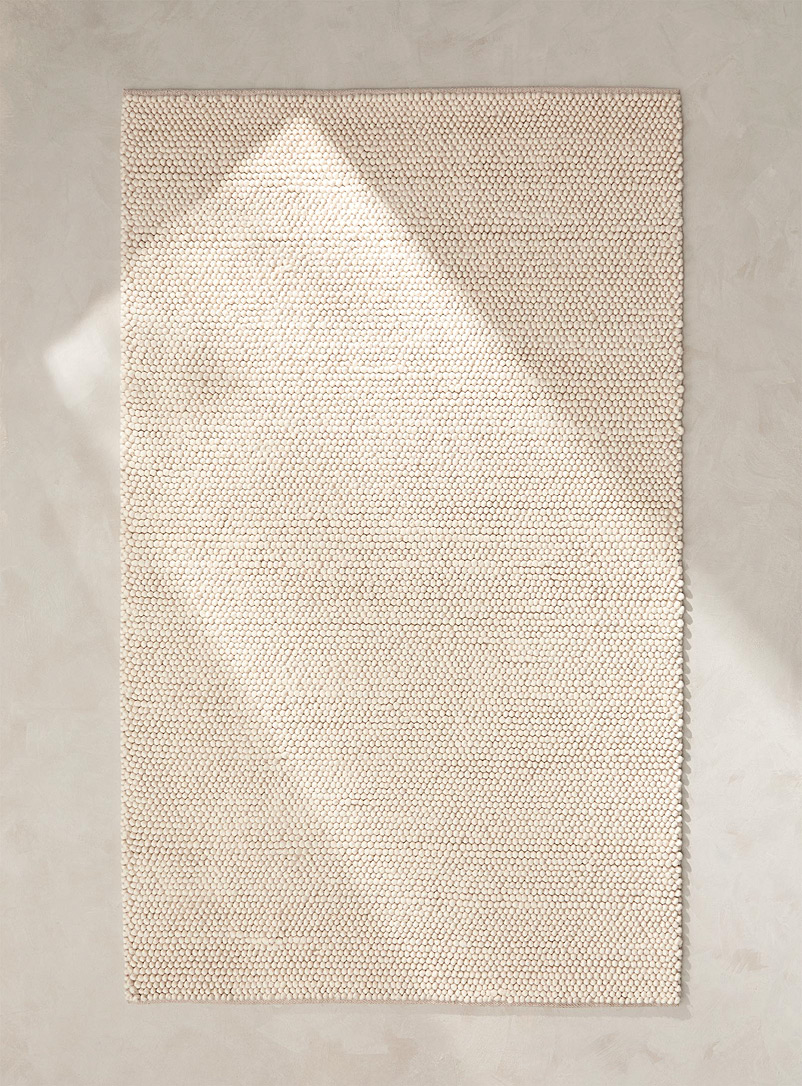
Rectangular looped-wool rug shown flat from above with dense rounded loop texture, narrow bound edges and a slightly irregular right edge where loops protrude. A diagonal light patch and soft shadows fall across the surface.
- Overall shapeRectangular rug with straight edges on three sides and a slightly uneven right edge where some loops protrude forming a narrow irregular fringe
1 region
x 0.06 · y 0.03 · w 0.88 · h 0.94 (high) - Surface textureDense field of small, tightly packed rounded wool loops creating a pebble-like texture across the entire face
1 region
x 0.08 · y 0.06 · w 0.84 · h 0.88 (high) - Edge bindingNarrow stitched binding visible along the top, left and bottom edges matching the rug color and forming a clean border
3 regions
x 0.06 · y 0.03 · w 0.88 · h 0.06 (medium); x 0.06 · y 0.91 · w 0.88 · h 0.06 (medium); x 0.06 · y 0.03 · w 0.06 · h 0.88 (medium) - Right-edge irregularityRight margin shows small clusters of loops that extend beyond the bound edge producing a faint scalloped or fringe effect
1 region
x 0.92 · y 0.08 · w 0.06 · h 0.84 (high) - Lighting and shadow on productDiagonal triangular area of stronger light from near the top center slanting down toward the center-left, creating subtle contrast across the loop texture
1 region
x 0.28 · y 0.04 · w 0.48 · h 0.46 (high)
Other
Top-down styled product shot on a neutral plaster-like background with soft directional lighting creating a diagonal highlight and minimal shadowing. No props or packaging visible.
- Shot compositionTop-down view with the rug centered in the frame and even margins of background visible on all sides
1 region
x 0.00 · y 0.00 · w 1.00 · h 1.00 (high) - Background surfaceSmooth, light beige plaster or concrete floor with subtle trowel texture visible around the rug
1 region
x 0.01 · y 0.01 · w 0.98 · h 0.98 (high) - Lighting qualitySoft directional daylight creating a distinct diagonal bright patch and gentle shadows, with even overall exposure
1 region
x 0.20 · y 0.02 · w 0.60 · h 0.60 (high)
Colors
warm cream· loop pile#F4EDE3soft beige shadow· shadowed loop recesses#FBEAD5- Overall shapeRectangular rug with straight edges on three sides and a slightly uneven right edge where some loops protrude forming a narrow irregular fringe
- 02
Product
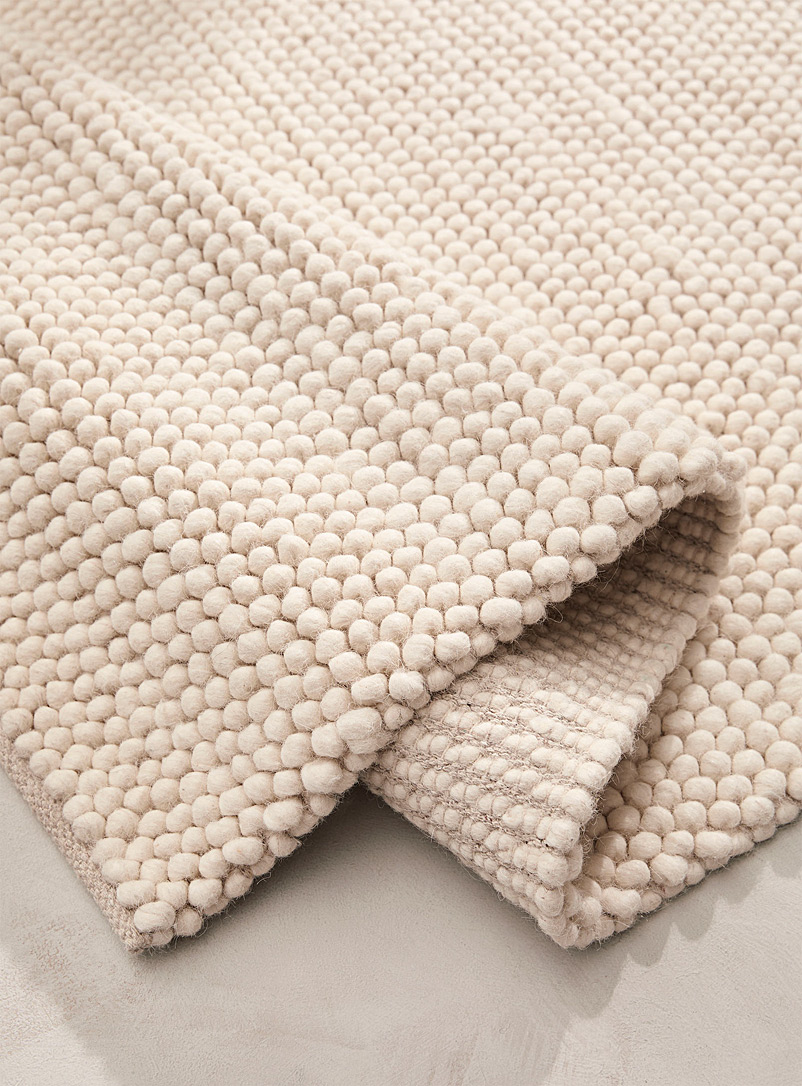
Close-up of a folded wool rug showing dense round looped pile on the face and a woven backing visible at the folded edge.
- Looped pile textureSurface covered with tightly packed spherical wool loops forming a pebble-like texture across the visible face of the rug.
1 region
x 0.02 · y 0.00 · w 0.96 · h 0.72 (high) - Folded cornerRug is folded back near the center-right of the image, creating a visible crease and revealing the rug backing underneath.
1 region
x 0.40 · y 0.28 · w 0.52 · h 0.48 (high) - Woven backingExposed underside shows a grid-like woven structure with parallel rows of yarn and a flatter loop base contrasting the raised face.
1 region
x 0.56 · y 0.52 · w 0.32 · h 0.30 (high) - Edge finishOuter edge visible at bottom-left shows loops finishing flush to a stitched borderline without a separate fringe.
1 region
x 0.00 · y 0.60 · w 0.30 · h 0.35 (medium) - Fiber appearanceIndividual wool fibers appear slightly fuzzy with soft halo and short stray fibers visible on some loops.
1 region
x 0.30 · y 0.20 · w 0.40 · h 0.40 (medium)
Other
Neutral smooth backdrop with soft directional lighting from upper-left creating subtle shadows between loops; image is a tight product detail shot cropped to the rug.
- Shot compositionTight close-up detail shot focusing on texture and a folded section; product fills most of the frame and is cropped at the edges.
- Background surfaceSmooth stone- or plaster-like neutral surface beneath the rug visible at the bottom and lower-left, slightly darker than the rug.
1 region
x 0.00 · y 0.80 · w 0.80 · h 0.20 (high) - Lighting and shadowSoft directional lighting from the upper-left produces gentle shadows between loops and a highlight on the raised fold.
Colors
warm cream· looped pile face#F5EDE2light tan· woven backing#B39A86- Looped pile textureSurface covered with tightly packed spherical wool loops forming a pebble-like texture across the visible face of the rug.
Variants
7 SKUs| SKU | Title | Price | Avail |
|---|---|---|---|
| 4180190 | Wool Loop Artisanal Rug See Available Sizes - Grey - 240x300cm | CA$798.00 | Yes |
| 4180185 | Wool Loop Artisanal Rug See Available Sizes - Grey - 150x240cm | CA$398.00 | Yes |
| 4180195 | Wool Loop Artisanal Rug See Available Sizes - Grey - 270x360cm | CA$1,098.00 | Yes |
| 4180186 | Wool Loop Artisanal Rug See Available Sizes - Off White - 150x240cm | CA$398.00 | Yes |
| 4180196 | Wool Loop Artisanal Rug See Available Sizes - Off White - 270x360cm | CA$1,098.00 | Yes |
| 4180187 | Wool Loop Artisanal Rug See Available Sizes - Ivory/cream Beige - 150x240cm | CA$398.00 | Yes |
| 4180197 | Wool Loop Artisanal Rug See Available Sizes - Ivory/cream Beige - 270x360cm | CA$1,098.00 | Yes |
Documents & Data
Customer Reviews
6 total6 reviews · out of 5
Love these wool rugs
I love these wool rugs is quality that I purchased two in different colours. I would highly recommend if you are looking for a quality rug!
Tapis artisanal boucles de laine
Perd beaucoup de laine.
Quality
This rug is amazing - the quality of the workmanship exceeded my expectations - i highly recommend this rug
Beautiful rug
I loved the texture and how warm it is. I want to buy the second one for my husband’s office
Love this wool rug
This rug is very quality love it and am thinking of purchasing a second one!
Perfection
Le tapis est arrivé en une semaine, bien emballé. Je l’ai commandé dans la couleur ivoire et c’est conforme à l’image. Le tapis est inodore, doux et ne « shed » pas particulièrement. Je recommande +++.